
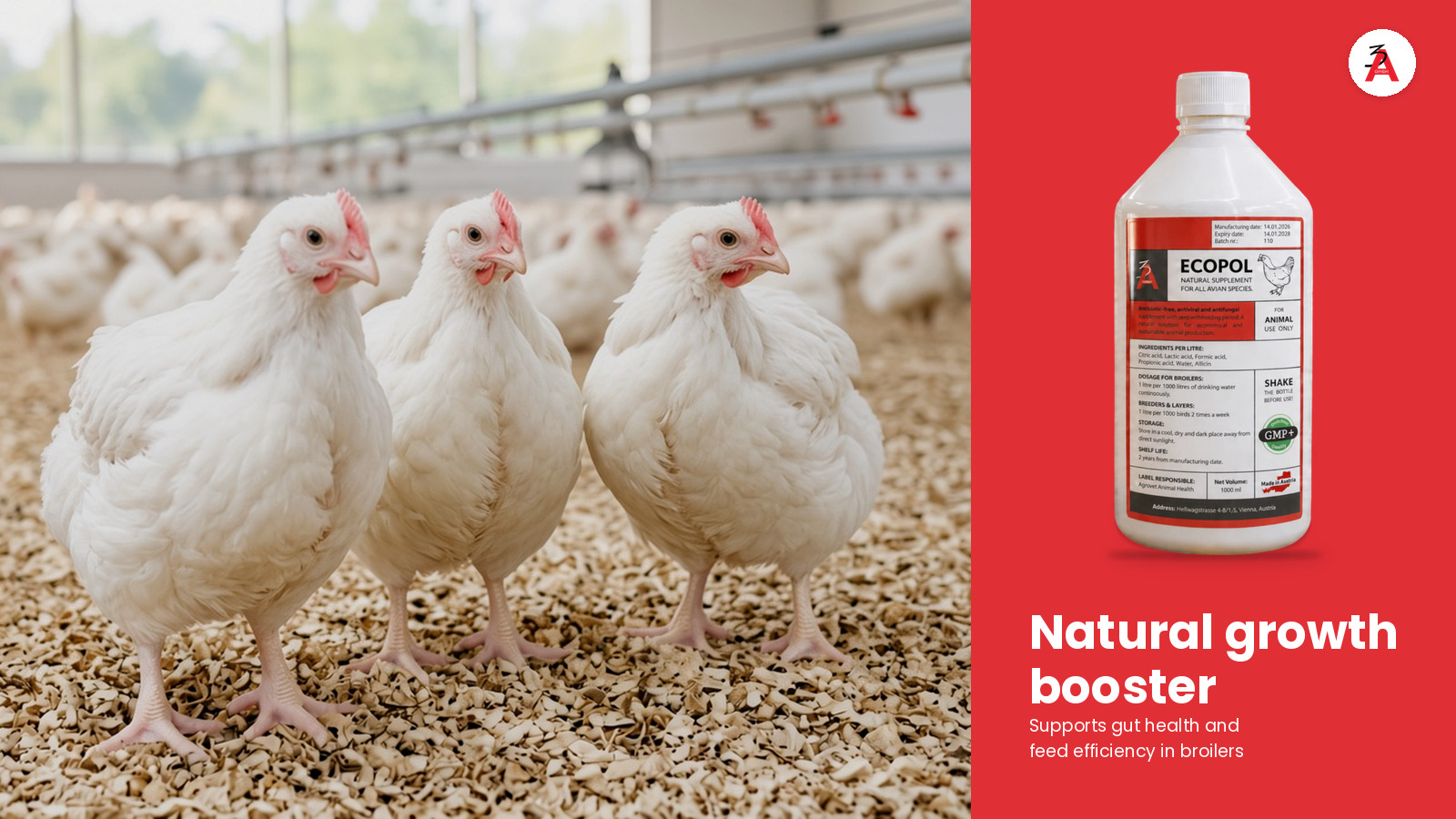
Short answer: Broiler feed conversion ratio (FCR) is decided much earlier than the scales at the end of the cycle suggest. A chick that finds feed and water within hours, keeps its gut stable and digests the fat in its starter diet sets the pattern for the whole flock. Good brooding comes first. A natural growth booster for broilers, such as an acidifier blend in the drinking water or a feed emulsifier, can then support gut integrity and fat digestion as part of that programme. It does not stand in for it.
What is FCR, and why does the first week matter so much?
FCR is simple arithmetic: kilograms of feed used divided by kilograms of live weight produced. Lower is better, and small differences carry large sums.
Take an illustrative flock of 20,000 birds sold at an average of 2.4 kg. That is 48 tonnes of live weight. At an FCR of 1.60 the flock eats 76.8 tonnes of feed; at 1.55 it eats 74.4 tonnes. The 0.05 gap is 2.4 tonnes of feed, from one house, in one cycle. Multiply by the number of houses and cycles per year and the case for chasing hundredths of a point is obvious.
The first week punches far above its weight in that calculation. The Ross Broiler Management Handbook 2025 notes that feed eaten in the first 10 to 14 days is only a small part of the total feed bill, which is why starter decisions should be driven by biological performance rather than the price per tonne. The same handbook sets a clear benchmark: body weight at day 7 should be at least 4.5 times the chick's weight at placement.
This is where much of the variation in a flock is created: a chick that starts late often stays behind, and an uneven flock rarely converts feed as well as a uniform one.
What affects gut integrity in young broilers?
The gut of a day-old chick is still developing. It has to switch from the yolk sac to a crumbled starter diet within hours, build up its digestive enzymes and settle its microbial population, all while the bird more than quadruples its weight in the first week. Four things on the farm push that process in the right or wrong direction:
- Feed. Starter quality, crumble size and how quickly the chick reaches it. Raw material variation and poorly digested nutrients leave substrate in the hindgut for unwanted microbes.
- Water. Temperature, flow, line hygiene and pH. Water is one of the first things a chick takes in and the easiest route for anything that should not reach the gut.
- Microbiome. The first bacteria to colonise the gut shape the balance that follows. Clean, dry litter and clean drinker lines help the right ones get there first.
- Load. Transport, chilling, overheating, high stocking density, and later the switch from starter to grower. Each of these is a stress the gut has to absorb.
When gut integrity slips, the bird spends nutrients on repairing tissue and coping with challenge instead of growing. That shows up as wet litter, poor uniformity and a worse FCR long before anyone calls it a health problem.
Why do young chicks struggle to digest fat?
Fats and oils are the most concentrated energy source in a broiler diet, which is why nutritionists add them to starter and grower feeds. The catch is that fat does not dissolve in the watery environment of the small intestine. To be absorbed it has to be emulsified into tiny droplets, a job done mainly by bile salts.
Young birds cannot yet produce enough bile salts and digestive enzymes to digest added fats and oils efficiently, and their digestive system takes up to seven weeks to become fully functional. On a broiler farm that is roughly the length of the whole cycle. Part of the energy you paid for in the oil tank can therefore pass through the bird unused.
This is the job of a feed emulsifier for poultry. Our 3A Emulsifier is a lecithin-based powder (soy lecithin, yeast cell wall and bentonite clay) that mimics and fortifies the effect of natural bile salts to support the absorption of fat and fat-soluble vitamins. We recommend 300 g per tonne of finished broiler feed. It is supplied in 25 kg bags.
Two practical points when you assess an emulsifier: check the fat level and fat source in your current formula, because the more fat the diet carries, the more there is to gain from digesting it well; and agree with your nutritionist whether the energy value of the diet will be adjusted or kept the same, so that you know what you are comparing.
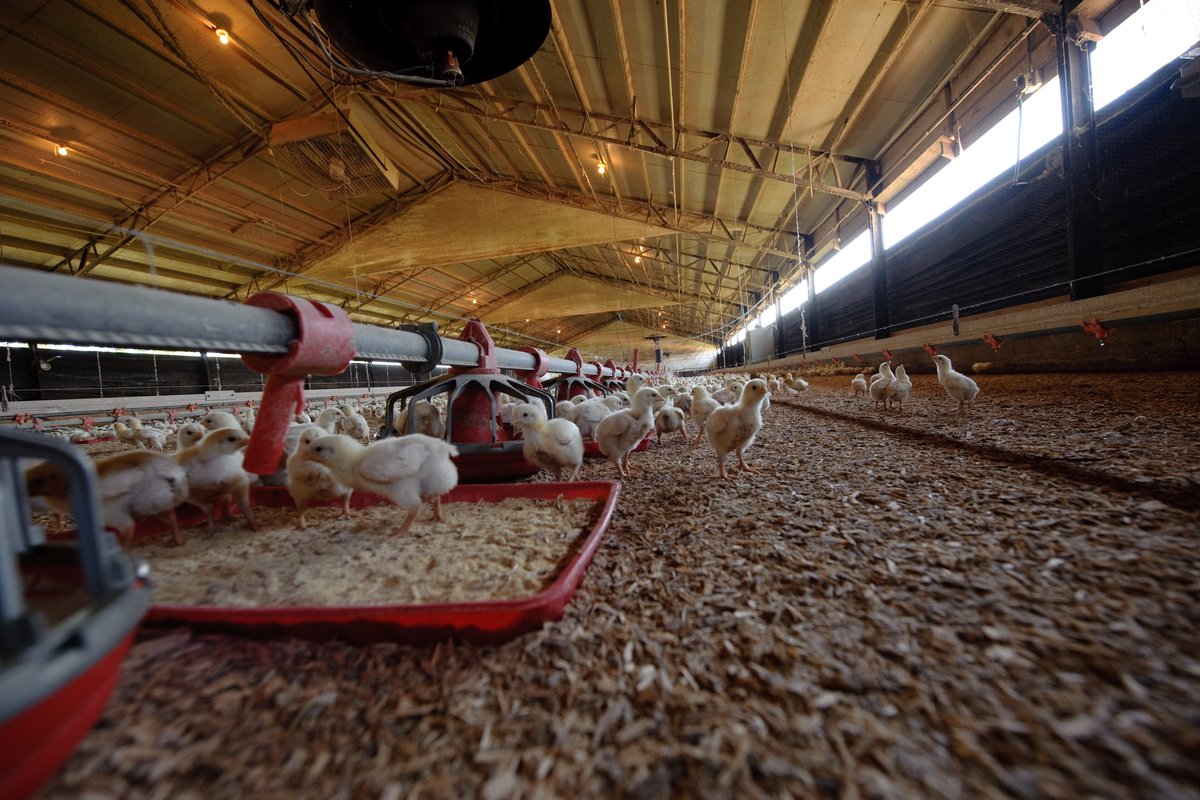
Photo: USDA NRCS Texas, public domain (Wikimedia Commons).
What does a good first-week checklist look like?
The targets below are taken from the Ross Broiler Management Handbook 2025. Your breed company and your vet may set different values for your house type and climate; the point is to have a written target and to check against it.
Add one line of your own: what goes into the water and feed from day 0, with start date, dose and batch, so the flock record shows what the birds actually received.
Where does a natural growth booster for broilers fit?
Once brooding, water and feed are right, nutrition tools can help the gut cope with the load of intensive production. They are not a substitute for the checklist above, and on their own they will not rescue a flock that started badly. Used as part of a programme, they can make a good start more consistent.
Our Ecopol is a drinking-water solution that combines an acidifier blend (citric, lactic, formic and propionic acids) with allicin, a sulfur compound derived from garlic. It is designed to support intestinal health and a balanced gut microbiota and is suitable for all avian species. We recommend two dosing patterns: 5 L per 1,000 L of drinking water per day for 7 days for short-term use, or 1 L per 1,000 L throughout the growing period. Ecopol is supplied as an oral solution in 1 L bottles.
3A Emulsifier works on a different part of the same problem: getting energy out of the fat already in the ration. Ecopol goes in the water, the emulsifier goes in the feed, so the two can be planned together without changing the feed formulation for Ecopol.
A word on language. Many people search for the "best growth promoter for poultry". In the EU, antibiotics have not been allowed as growth promoters in feed since 1 January 2006 (European Commission, IP/05/1687). What modern programmes aim for is better growth performance through gut health, digestibility and management, and that is the honest frame for any additive, ours included. If you want the wider context on cutting antibiotic use, see our article on natural alternatives to antibiotics in animal feed.
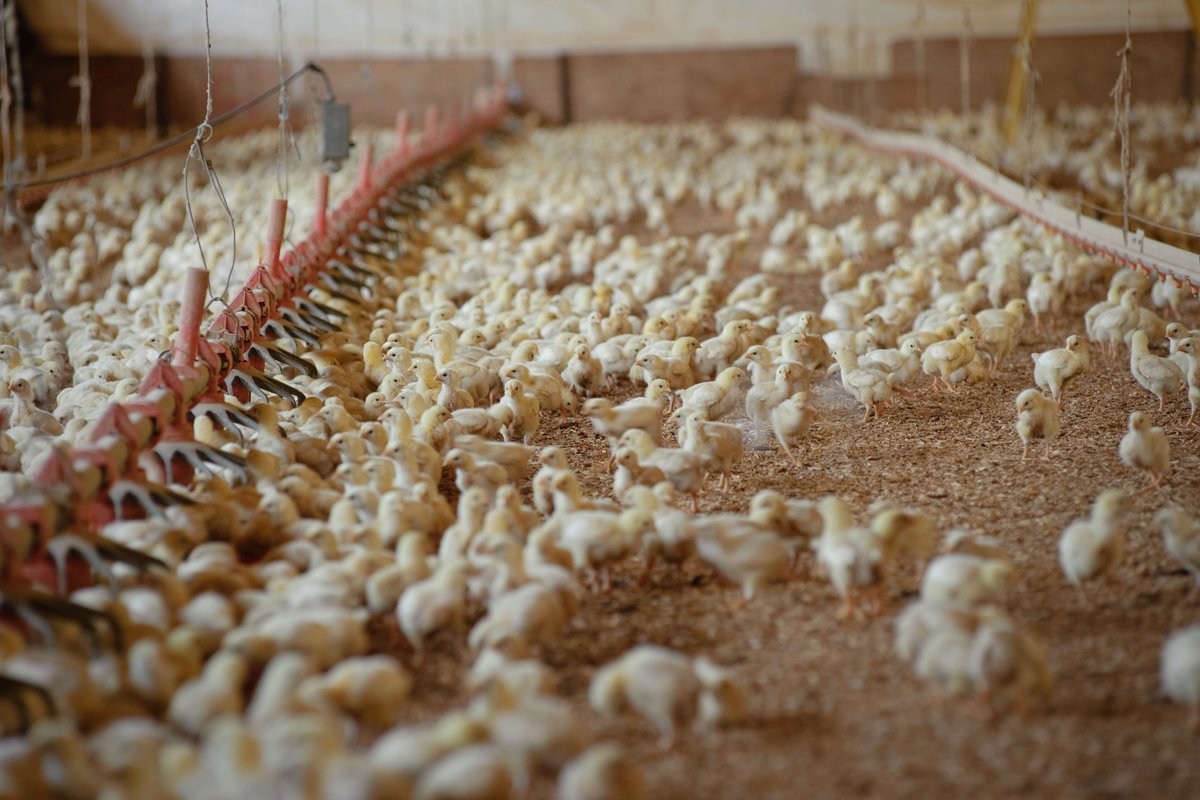
Photo: USDA NRCS Texas, public domain (Wikimedia Commons).
How do you check the result on your own farm?
The only comparison that counts is one you can trust. A few rules make the difference between a real result and a coincidence:
- Compare like with like. Same house or matched houses, same chick source and parent flock age, same feed mill and formulation, same season where possible.
- Run more than one cycle. One flock can be thrown off by a hot week or a weak chick delivery. Two or three cycles give you a pattern.
- Record the same indicators every time. Day-0 and day-7 weights and CV%, crop fill at 24 h, water intake, litter score, FCR at slaughter, average daily gain, uniformity at catching, and any veterinary interventions.
- Correct FCR for weight. Heavier flocks naturally have a higher FCR, so compare at the same target weight or use the weight-adjusted FCR your integrator uses.
- Write down the cost side. The cost per tonne of feed or per 1,000 L of drinking water dosed, set against the value of the change in FCR and weight. That is the number your manager will ask for.
If you want to dig deeper into the growth side, our article on how to achieve faster broiler weight gain covers it in more detail. Protein sources matter too; see yeast protein versus soybean meal in poultry feed.
FAQ
What is a good FCR for broilers?
It depends on breed, target weight, sex mix and climate, so there is no single number. Compare against your breed company's performance objectives for the same weight, and against your own previous flocks in the same house.
How can I improve FCR in broilers quickly?
Start with what costs least: brooding temperature, water quality and line hygiene, crop fill checks and feeder space in the first days. Then review fat digestion and gut support in the starter phase. Changes in the first week tend to show up across the whole cycle.
Is a feed emulsifier worth it in poultry diets?
It is most relevant where diets carry a meaningful amount of added fat or oil and where young birds are fed energy-dense starters. Run it as a planned comparison over several flocks and judge it on FCR, weight and cost per kilogram of gain.
Can Ecopol and 3A Emulsifier be used together?
Yes. They work by different routes: Ecopol in the drinking water and 3A Emulsifier in the feed. Follow the dosage we recommend for each product and agree the programme with your nutritionist and vet.
The bottom line
FCR is won or lost in the first week. Get the house, the water and the chick start right, measure them, and then use nutrition as support: an acidifier blend in the water for gut integrity, an emulsifier in the feed for fat digestion. Judge every change on your own flock data over more than one cycle.
To discuss a programme for your farm or feed mill, contact us at office@3a-austria.eu or +43 664 205 8093, or see the product pages for our Ecopol and 3A Emulsifier.