A dairy cow doesn't usually get sick because a germ got lucky. She gets sick because, for a few critical weeks, her own defences were switched to low power — and the germ was already there, waiting.
That window has a name: the transition period, the three weeks either side of calving. Somewhere around 75% of dairy cow disease happens in the first month of lactation. Mastitis, metritis, retained placenta, displaced abomasum — different diseases, one shared backdrop: an immune system running on empty. Understanding dairy cow immune support means understanding why that happens, and what nutrition can and cannot do about it.
That window has a name: the transition period, the three weeks either side of calving. Somewhere around 75% of dairy cow disease happens in the first month of lactation. Mastitis, metritis, retained placenta, displaced abomasum — different diseases, one shared backdrop: an immune system running on empty. Understanding dairy cow immune support means understanding why that happens, and what nutrition can and cannot do about it.
Why the Immune System Fails at Exactly the Wrong Time
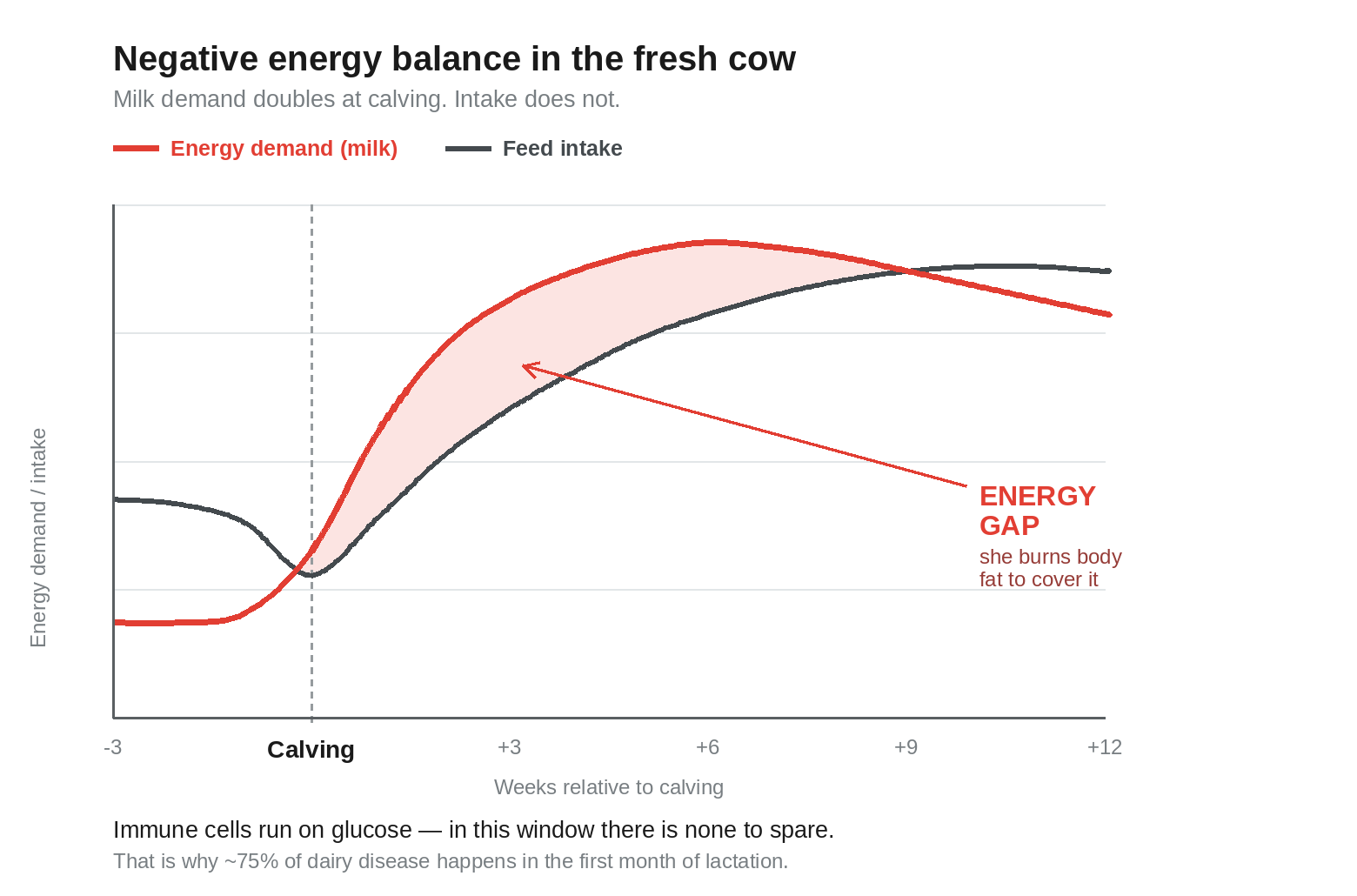
Here is the cruel arithmetic of the fresh cow. The day she calves, her energy demand roughly doubles as milk production starts. But her appetite doesn't — dry matter intake actually drops around calving and takes weeks to catch up.
So she does what any mammal does: she burns body fat to cover the gap. This is negative energy balance, and every fresh cow goes through it. The problem is what it does to her immune cells.
Immune cells run on glucose. Neutrophils and lymphocytes — the cells that hunt bacteria in the udder — are heavy glucose users. When a cow is pouring glucose into milk and mobilising fat to survive, blood glucose is scarce, and her immune cells are effectively told to ration. Their ability to find and kill bacteria measurably declines in the weeks around calving. The infection didn't get stronger; the defence got weaker.
This is why you cannot supplement your way out of a bad transition with a single mineral. If the energy foundation is missing, the whole immune system is underpowered no matter what else is in the ration.
So she does what any mammal does: she burns body fat to cover the gap. This is negative energy balance, and every fresh cow goes through it. The problem is what it does to her immune cells.
Immune cells run on glucose. Neutrophils and lymphocytes — the cells that hunt bacteria in the udder — are heavy glucose users. When a cow is pouring glucose into milk and mobilising fat to survive, blood glucose is scarce, and her immune cells are effectively told to ration. Their ability to find and kill bacteria measurably declines in the weeks around calving. The infection didn't get stronger; the defence got weaker.
This is why you cannot supplement your way out of a bad transition with a single mineral. If the energy foundation is missing, the whole immune system is underpowered no matter what else is in the ration.
The Nutrients That Actually Move Immunity
Once energy is accounted for, specific nutrients become the difference between a cow that clears a challenge and one that doesn't. These are not vague 'immune boosters' — each has a defined job.
The selenium–vitamin E pairing is the one with the strongest field evidence: herds marginal in both consistently show more mastitis and more retained placentas, and correcting them measurably helps. But notice the pattern in that last column — deficiencies are common, regional, and often invisible until they show up as a disease rate you can't explain.
The Rumen: The Immune Organ Nobody Calls One
Roughly 70% of a cow's immune activity sits around the gut. That makes the rumen — and the gut wall behind it — central to immunity, not a side issue.
Two things matter here. First, a stable rumen keeps producing the energy the immune system needs; an acidotic rumen (pH below ~5.8) does the opposite. Second, when the rumen wall or gut lining is inflamed, it can leak — letting bacterial toxins into the bloodstream, which drags the whole system into a low-grade inflammatory state that burns energy and suppresses the targeted response you actually want.
Keeping the rumen stable and the gut wall intact is therefore one of the highest-leverage things you can do for immunity — and it is exactly where functional feed additives earn their place.
Two things matter here. First, a stable rumen keeps producing the energy the immune system needs; an acidotic rumen (pH below ~5.8) does the opposite. Second, when the rumen wall or gut lining is inflamed, it can leak — letting bacterial toxins into the bloodstream, which drags the whole system into a low-grade inflammatory state that burns energy and suppresses the targeted response you actually want.
Keeping the rumen stable and the gut wall intact is therefore one of the highest-leverage things you can do for immunity — and it is exactly where functional feed additives earn their place.
Where VF Care Fits
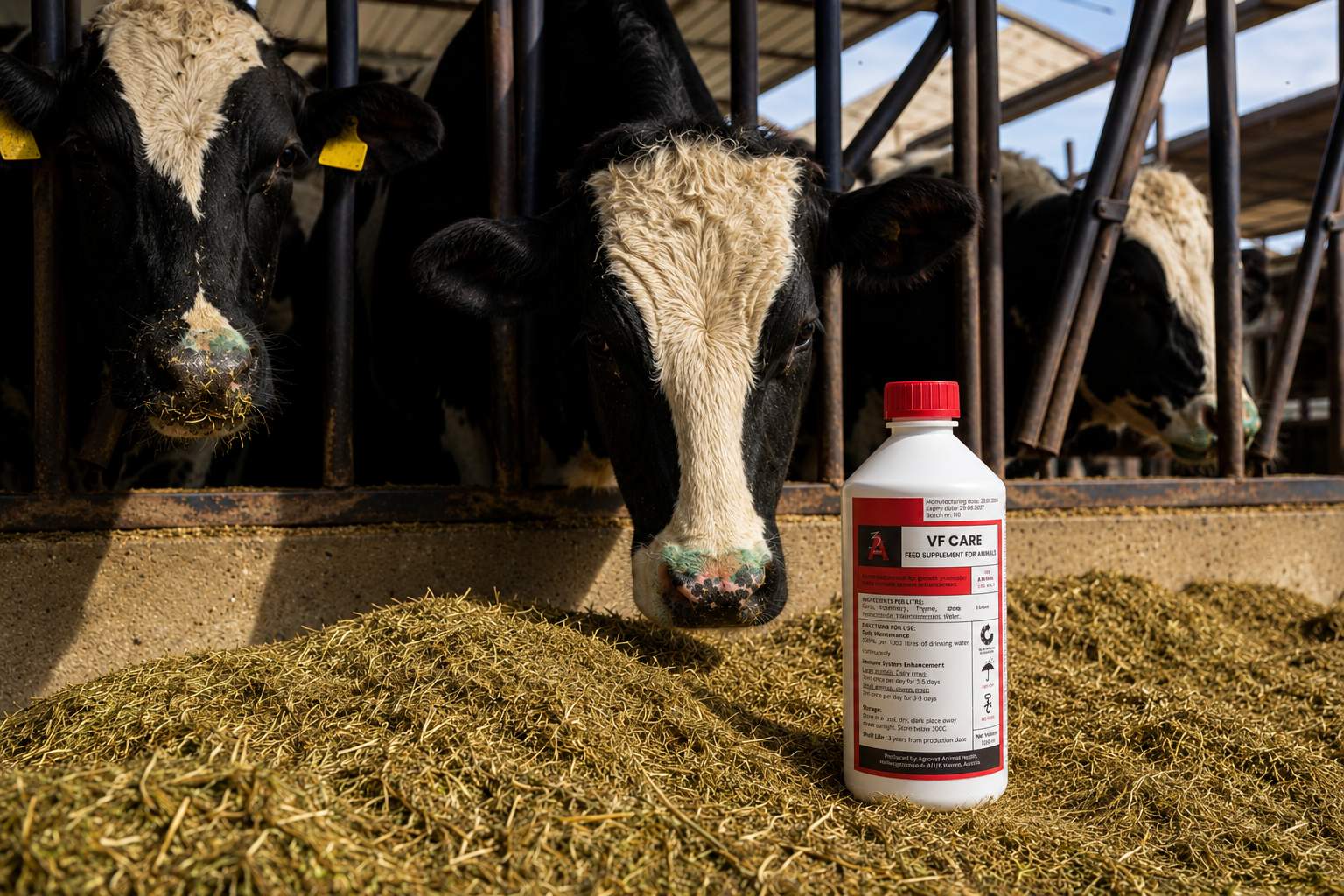
VF Care is an antibiotic-free herbal oral solution developed by Agrovet for cattle and ruminants. It is built for the exact moment described above — the cow under load who is going off feed and losing ground.
Used alongside a balanced ration, it supports appetite and feed intake, supports the cow's own immune response, and supports recovery through the transition period and other health-challenge windows — with no withdrawal period, so milk stays saleable throughout. Keeping a fresh or challenged cow eating is not a small thing: intake is energy, and energy is what her immune cells are short of.
It works with your herd health programme, not instead of it. When a bacterial infection needs antibiotics, it needs antibiotics — VF Care sits alongside that, and alongside good udder health and management practice, as nutritional and supportive care.
Used alongside a balanced ration, it supports appetite and feed intake, supports the cow's own immune response, and supports recovery through the transition period and other health-challenge windows — with no withdrawal period, so milk stays saleable throughout. Keeping a fresh or challenged cow eating is not a small thing: intake is energy, and energy is what her immune cells are short of.
It works with your herd health programme, not instead of it. When a bacterial infection needs antibiotics, it needs antibiotics — VF Care sits alongside that, and alongside good udder health and management practice, as nutritional and supportive care.
Nutrition Is Half the Equation — Management Is the Other Half
The best-formulated ration in the world cannot rescue a cow fighting the barn. Immunity is spent, not just fed, and these quietly drain it:
Watch the early signals, too. A dip in intake, a slide in body condition, a creeping bulk-tank cell count — these show up before a clinical case does, and they are your chance to act while it is still cheap.
- Heat stress — a heat-stressed cow eats less, and less intake means less energy for immune cells
- Overcrowding and poor ventilation — higher pathogen load hitting an already-taxed system
- Inconsistent feed and empty troughs — every intake dip is an immunity dip
- Dirty water or too few drinking spaces — caps intake before nutrition can lift it
Watch the early signals, too. A dip in intake, a slide in body condition, a creeping bulk-tank cell count — these show up before a clinical case does, and they are your chance to act while it is still cheap.
Why This Pays
A clinical disease is never just the treatment cost. A case of clinical mastitis, once you count discarded milk, lost yield, treatment, labour and a raised culling risk, runs into the hundreds of euros per cow — and subclinical cases drain milk silently the whole time.
Immune support through nutrition is preventive spending against that. It will not make disease impossible. What it does is stack the odds — a cow whose energy status, trace minerals and gut are in order clears challenges that would put a compromised herdmate in the treatment pen.
Immune support through nutrition is preventive spending against that. It will not make disease impossible. What it does is stack the odds — a cow whose energy status, trace minerals and gut are in order clears challenges that would put a compromised herdmate in the treatment pen.
Conclusion
Dairy cow immune support is not a product you add — it is a state you maintain, mostly by getting energy balance, trace minerals, rumen health and management right during the periods when the immune system is under the most strain.
Start with the transition period, because that is where the disease is. Cover the energy gap, correct the trace minerals your region is short of, keep the rumen stable, and keep cows eating through stress. Do that, and most of the disease you currently treat never reaches the point of needing treatment.
Start with the transition period, because that is where the disease is. Cover the energy gap, correct the trace minerals your region is short of, keep the rumen stable, and keep cows eating through stress. Do that, and most of the disease you currently treat never reaches the point of needing treatment.
FAQs
What is dairy cow immune support?
It is the combination of nutrition and management that keeps a cow's own immune system working normally, especially during high-stress periods like the transition around calving. It is not a single additive — it is energy balance, trace minerals, rumen health and good management working together.
Why do so many cows get sick right after calving?
Because energy demand doubles at calving while intake drops, so cows burn body fat to cover the gap. Immune cells depend on glucose, which is scarce in that state — so their ability to fight bacteria falls at exactly the moment infection pressure is highest. Around 75% of dairy disease occurs in the first month of lactation for this reason.
Which nutrients matter most for immunity?
Energy first — without it nothing else works. Then the selenium–vitamin E pair (strongest link to lower mastitis), zinc for barrier tissue, copper and manganese for antioxidant enzymes, and vitamin A for mucosal barriers. Many herds are marginal in these without knowing it.
How does rumen health affect immunity?
Around 70% of immune activity is gut-associated. A stable rumen keeps supplying energy and keeps the gut wall intact; an acidotic or leaky gut lets toxins into the blood and pushes the cow into low-grade inflammation that suppresses her targeted immune response.
Can feed additives improve immune health in dairy cows?
Used alongside balanced nutrition, yes — particularly those that support intake, rumen stability and gut integrity, since those underpin the energy and barrier function the immune system depends on. They complement good nutrition and management; they do not replace them.
How does Agrovet support dairy cow immunity?
Agrovet's VF Care is an antibiotic-free herbal oral solution that supports appetite, the cow's own immune response and recovery through transition and health-challenge periods — with no withdrawal period on milk. It is used alongside veterinary care and good management as part of a complete herd health programme.