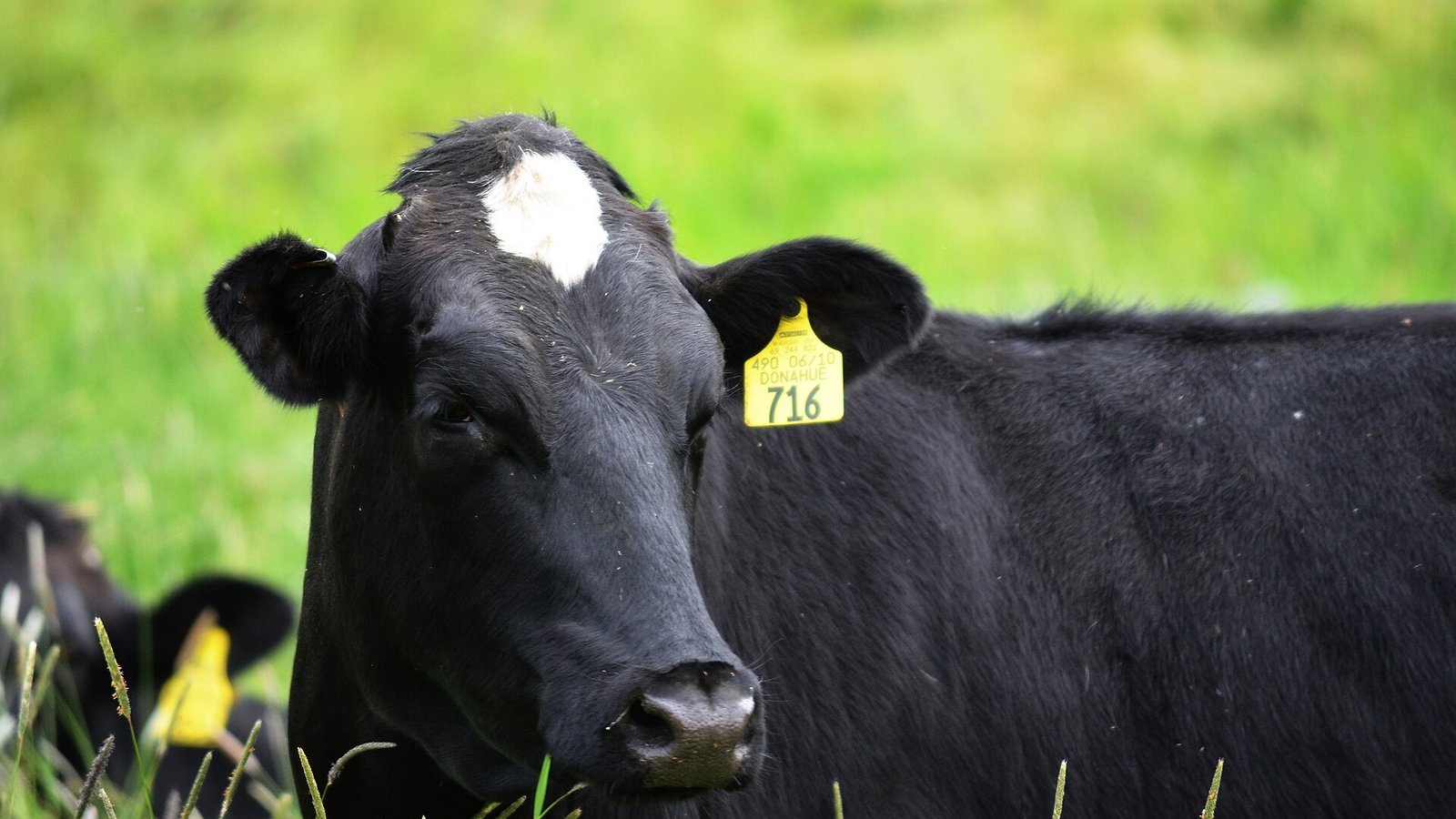
Photo: Carolyn Parsons, Wikimedia Commons, CC BY-SA 4.0.
Short answer: Choline helps the liver move fat out as lipoproteins. Around calving, a dairy cow mobilises body fat faster than her liver can export it, so her choline need rises. Free choline in the feed is almost completely broken down by rumen microbes, which is why transition cows need a rumen-protected form. Published meta-analyses show that rumen-protected choline fed from about three weeks before to three weeks after calving supports milk yield and component yields in multiparous cows. It works best as part of a well-managed transition ration, not as a substitute for one.
This guide is part of our dairy series. For milk quality basics, see our udder health and milk quality checklist. For the protein side of the ration, read our guide to rumen-protected lysine and methionine.
Why is the transition period so demanding?
The transition period covers roughly the three weeks before and the three weeks after calving. In these six weeks, feed intake drops just as the energy needed for the calf and for the start of lactation climbs steeply. The cow closes the gap by mobilising body fat, which reaches the liver as non-esterified fatty acids (NEFA).
The liver can burn part of these fatty acids for energy or package them as triglycerides and export them in very-low-density lipoproteins (VLDL). In cows, this export route is slow. When more fat arrives than leaves, triglycerides build up in liver cells. A recent literature review in the Journal of Dairy Science estimates that about 40% to 50% of dairy cows develop some degree of fatty liver in the first weeks of lactation, and higher liver fat is linked to more health problems around calving and lower performance.
That is why nutritionists see the liver as the centre of transition management. Everything that supports liver fat export, intake and energy balance in these weeks pays back over the whole lactation.
What does choline do in the cow?
Choline is a vitamin-like nutrient with several jobs:
- Fat export from the liver. Choline is needed to make phosphatidylcholine, a key part of the VLDL particles that carry triglycerides out of the liver. This is why choline is called a lipotropic nutrient.
- Cell membranes. Phosphatidylcholine is a structural part of every cell membrane.
- Methyl donor. Through betaine, choline supplies methyl groups to the same metabolic pathways that use methionine.
- Nerve signals. Choline is a building block of acetylcholine.
- Fat digestion. Research reviews suggest choline also supports fat absorption in the gut by helping enterocytes package dietary fat.
A cow makes some choline herself and gets some from feed, but the supply at the intestine is low, because rumen microbes degrade most of the choline in the diet. Around calving, the need for VLDL export is at its peak, so the gap becomes most visible.
Why must choline be rumen-protected?
Free choline chloride added to a dairy ration is broken down in the rumen before the cow can absorb it. Rumen-protected choline (RPC) solves this with a coating, usually a matrix of fatty acids or fats, that rumen microbes cannot easily digest. Further down the gut, digestive enzymes break the coating and release choline for absorption in the small intestine.
Unprotected choline chloride still has a place. It is a standard ingredient in poultry and pig feed, where there is no rumen. Our 3A Choline is choline chloride on a corn cob carrier for these monogastric diets. For dairy cows, the coated form is the one that matters.
| At a glance | Unprotected choline chloride | Rumen-protected choline |
|---|---|---|
| Main use | Poultry and pig feed | Dairy and beef cattle, sheep and goats |
| In the rumen | Largely degraded by microbes | Coating resists microbial breakdown |
| Where choline is absorbed | Small intestine in monogastric animals | Small intestine, after the coating is digested |
| Key question for the buyer | Choline chloride content and carrier | How much choline passes the rumen and is released |
| Our product | 3A Choline | 3A Cholycoat 30% |
What does the research show?
Rumen-protected choline is one of the best-studied transition supplements. Two meta-analyses in the Journal of Dairy Science summarise the evidence:
- More milk and components when fed through transition. A 2020 meta-analysis of 21 experiments with 1,313 multiparous cows found that increasing choline ion fed from before calving linearly increased dry matter intake before and after calving and the yields of milk, energy-corrected milk, fat and protein. At the median supplementation of 12.9 g of choline ion per day, milk yield rose by about 1.6 kg per day.
- A dose-response curve. A 2025 dose-response meta-analysis of 30 studies found that milk yield peaked at about 13 g per day of choline chloride, with an increase of about 1.3 kg per day, and recommended a total dose of 13 to 14 g per day to increase milk yield.
- Methionine changes the response. In the 2020 analysis, the milk response to choline became smaller as the methionine supply after calving increased. The two nutrients interact, but methionine cannot fully take over choline's role.
- Effects outlast the feeding period. Research reviews report that the performance benefit of feeding rumen-protected choline during transition extends well beyond the weeks of supplementation, regardless of the cow's body condition.
- Data on heifers are limited. Most trials used multiparous cows. There is not yet enough research to say how first-calf heifers respond.
Earlier reviews of fatty liver management also name rumen-protected choline as one of two nutritional tools with the best evidence for supporting liver fat export, alongside propylene glycol.
These results describe rumen-protected choline as a class of feed ingredient, not any one product. Note that studies report doses as grams of choline ion or choline chloride, not grams of product.
| Feeding window | What the research suggests |
|---|---|
| About 21 days before calving | Start here; intake before calving rose with choline in the 2020 analysis |
| First 3 weeks after calving | Continue feeding; liver fat load is highest in early lactation |
| Mid-lactation | Little research focus; the main benefit is tied to transition |
| First-calf heifers | Not enough data yet |
| High-methionine rations after calving | The milk response to choline tends to be smaller |
How to choose a rumen-protected choline product
Products differ more than labels suggest. Ask your supplier these questions before you compare prices:
- How much choline does one gram of product deliver? Compare products on the choline the cow actually receives, not on grams per head.
- How much passes the rumen? This is the bypass value, and it should come with a method you can check.
- How much is released in the intestine? A coating that resists everything also keeps choline from the cow.
- Is it stable in the TMR and in storage? Heat, moisture and long mixing times can damage coatings.
- Who makes it and under what quality system? Ask for the manufacturer and its feed safety certification, such as GMP+.
Where our 3A Cholycoat 30% fits
Our 3A Cholycoat 30% is a rumen-protected choline for transition dairy cows. We coat choline chloride with a protective layer of fatty acids that rumen microbes cannot readily digest. Further along the gut, digestive enzymes break the coating down and release choline chloride for absorption in the small intestine.
3A Cholycoat 30% supports fat metabolism and liver function during the transition period. We recommend 20–50 g per cow per day, and your nutritionist sets the exact amount and feeding window for your ration. We produce it under GMP+ and supply it in 25 kg bags.
Choline and protein balance go together. If you are also balancing amino acids, our 3A Lycoat is a rumen-protected lysine for dairy cows. For the wider picture of cow health around calving, see our guide to dairy cow immune support.
Transition checklist for choline feeding
- Plan the close-up group so cows get at least three weeks of the close-up ration before calving.
- Start rumen-protected choline in the close-up ration and continue it through the first weeks after calving.
- Check the dose as choline delivered per day, not as grams of product.
- Keep feed intake high: fresh feed, enough bunk space and no overcrowding in close-up and fresh pens.
- Avoid over-conditioned cows at dry-off, because fat cows mobilise more body fat after calving.
- Review methionine supply after calving with your nutritionist, since it affects the response to choline.
- Track fresh-cow intake, early milk yield and components, and judge results over the whole early lactation.
FAQ
What is rumen-protected choline?
It is choline, usually choline chloride, coated so that it passes the rumen without being broken down by microbes and is released for absorption in the small intestine.
When should transition cows get rumen-protected choline?
Most research fed it from about three weeks before calving to about three weeks after. This is the period when liver fat load and the need for choline are highest.
How much choline does a dairy cow need?
A 2025 meta-analysis recommended a total of 13 to 14 g of choline chloride per day for milk yield. Product doses differ because products contain different amounts of choline, so compare the choline delivered.
Can methionine replace choline?
Not fully. Both supply methyl groups, but choline has its own role in liver fat export. Higher methionine after calving can make the milk response to choline smaller, so balance them together.
How much 3A Cholycoat 30% should I feed?
We recommend 20–50 g per cow per day. Your nutritionist sets the exact amount and the feeding window based on your ration.
The bottom line
Choline is the nutrient the cow's liver needs most when fat mobilisation peaks around calving, and only a rumen-protected form reaches the intestine. Fed through the transition period as part of a well-managed ration, it supports milk yield and component yields in the weeks that set up the whole lactation. We supply our products to farms and feed mills on 5 continents. To plan a transition programme with our team, write to office@3a-austria.eu.
Sources
- Arshad U., Zenobi M.G., Staples C.R., Santos J.E.P. (2020). Meta-analysis of the effects of supplemental rumen-protected choline during the transition period on performance and health of parous dairy cows. Journal of Dairy Science 103(1):282–300. PubMed
- Ghaffari M.H. et al. (2025). Effects of rumen-protected choline supplementation on lactation performance of dairy cows: a systematic review and dose-response meta-analysis. Journal of Dairy Science 108(9):9516–9534. PubMed
- Arshad U., Santos J.E.P. (2024). Graduate Student Literature Review: Exploring choline's important roles as a nutrient for transition dairy cows. Journal of Dairy Science 107(7):4357–4369. PubMed
- Grummer R.R. (2008). Review of nutritional and management strategies around fatty liver in dairy cattle. The Veterinary Journal 176(1):10–20. PubMed